BODMIN CHRONICLE - SPECIAL REPORT

Bodmin Gaol - where Eliza was imprisoned in 1859.
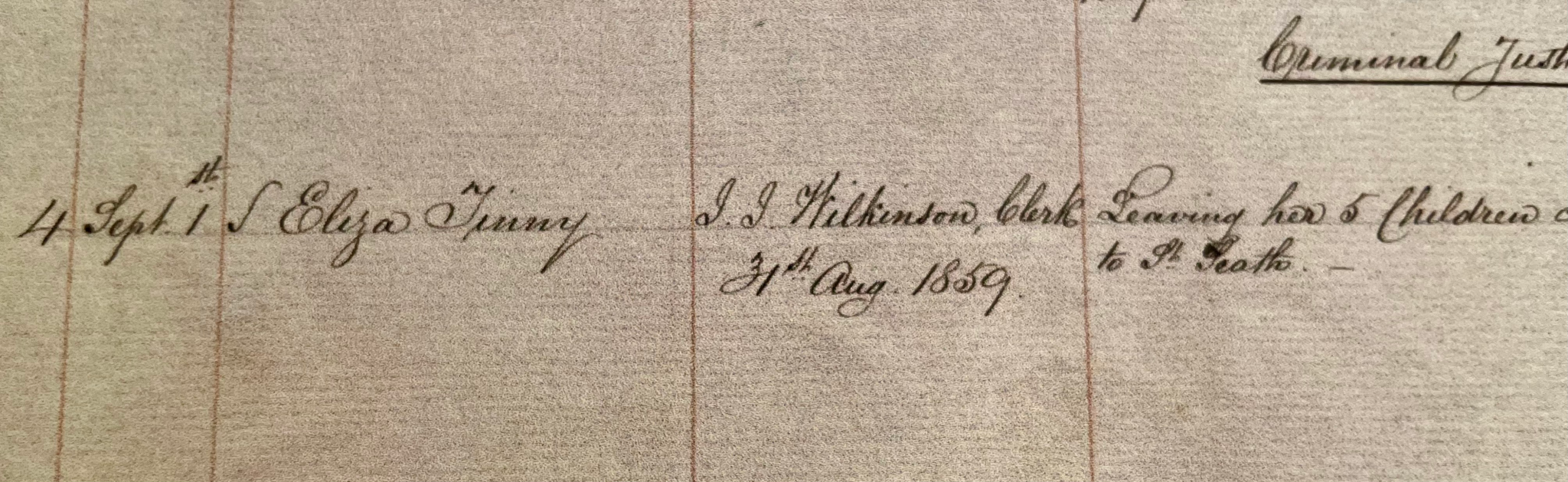
This happened to my 3xGreat Grandmother Eliza. She was sent to jail for a period of two weeks, for leaving her 5 children chargeable to St Teath, according to an entry in the Cornwall, England, Bodmin Gaol Records, 1821-1899, held in Ancestry.ca, with data provided by Patricia T. Fawcett and Sally J. Pocock in Cornish Prison Records from the Cornwall Record Office, Truro, Cornwall, England.
Case File: Eliza Tinney
- Born: c. 1822, South Zeal, Devon
- Residence: Tintagel, Cornwall
- Occupation: Charwoman
- Family: Married, 6 children
- Offense: Leaving children chargeable to parish
- Sentence: 14 days
- Committed: 31 August 1859
- Discharged: 1859
- Notes: Could not read or write; worked washing in prison
From this database entry, it shows that she was 37 at the time, that she is married with 6 children and working as a charwoman. In the prison, she earned her keep by doing washing. She was discharged in 1859.
Case no. 26404, she was committed on the 31st of August 1859 and received a summary conviction that had her spend 14 days in Bodmin Gaol. In the jail records, she is described as not receiving instruction, meaning, I think, that she could neither read nor write. Small in stature at 5 feet tall, she had an oval shaped face, a fresh complexion, hazel eyes, and brown hair. A cooking or laundry accident left her scarred on her neck and she had lost an upper front tooth.
"Fourteen days in Bodmin Gaol -- not for crime, but for poverty."
It confirms that she lives in Tintagel and was originally from South Zeal, Devon. At some point after this incident -- perhaps the impetus for it? -- Eliza and her family, including husband John, decide to emigrate to Canada. Knowing that she was imprisoned until 15 September 1859 and appears in the Canadian Census in 1861 in the township of Hamilton, Northumberland, Canada West, narrows the travel window considerably.
Eliza's husband, John Tinney, was a quarryman (slate), according to the 1851 England Census, and the family is residing in Tintagel, Cornwall. They had three children by this time. Obviously more came along before 1859. So many questions! Where was husband John during Eliza's difficulties? Where did he work? There are several quarries to be found in this part of Cornwall. Is it possible to uncover which one(s) he worked at? Did work take him away from home, was he injured or ill, or is something else going on? What happened to the children while she was in jail? What must that have been like for them?

Eliza and the working world that shaped her family's life.
Why Canada, why Northumberland county? There is another Tinney family in the county noted in the 1851 census, perhaps they were cousins of some sort and Eliza's family went to where they knew they had relatives already? Something to look into.
Thankfully the family, John and Eliza, and five children Selina (1844-1912), William (1847-1929), John (1849-1890), Thomas (1851-1940), and Tamzin (1853-1948), (yet another question: who and where is child 6?) made their way to Northumberland Co., Ontario, where they thrived. John continued to work as a stonemason and so did his son John. My direct ancestor, Eliza's son Thomas Tinney, became a blacksmith at Camborne (in Northumberland).
"Sam [Redpath] acquired the place in 1880 and became Camborne's well-known carpenter and builder... The shop was then rented to blacksmiths. Among the blacksmiths who worked at this shop were Tom Tinney and Tom McBride."
In a later census, Thomas Tinney's occupation is listed as carpenter, likely because the blacksmith shop at Camborne was closed by its owner and turned into a grist mill. Thomas used his skills as a craftsman to build a self-rocking cradle, and also applied for a Canadian patent. Perhaps some unpleasant memories for the two weeks he and his siblings were surrendered to the parish fed his desire to create a comforting and supportive tool for both mothers and babies?

Four generations - Summer of 1933 (estimated).
Week 2 challenge: favourite photograph. This image is among my favourites. Four generations with my dad as a wee one. Summer of 1933 I suspect. Thankfully these folks were able to migrate and thrive, and because of their adventurous spirit and tenacity, I am here.
Having kin from both Devon and Cornwall, I wonder if that is why I am ambivalent of the how to layer jam and cream debate?
"The only way to serve a scone is by putting on the jam first. It's easily spreadable, and visually, it looks much better with the jam on the bottom and a good spoon of Cornish clotted cream on top."